01 · Fire
~1,000,000 years ago
We reached toward what everything else ran from.
Every other animal fled the flames. One of us leaned in, got burned, and came back the next night. That is how it starts — not with knowing, but with wanting to know.
Human trait Curiosity
02 · The hand on the wall
~40,000 years ago
We painted what wasn't there.
By firelight, someone pressed a hand to the rock and blew pigment around it. Then they drew an animal that wasn't in the cave. A picture of something absent — one mind reaching for another.
Human trait Imagination
03 · Together
~12,000 years ago
We stayed for each other.
We settled, planted, and stayed. When one of us fell, another reached down. Civilization is, at bottom, a very long habit of pulling each other up.
Human trait Empathy
04 · Writing
~5,200 years ago
We learned to talk to people not yet born.
Wedges pressed into wet clay in Sumer — grain counts first, then laws, then poems. The sign for “sky” was a star. For the first time, a thought could outlive the person who had it.
Human trait Story
05 · Looking up
1609
We looked up and kept asking why.
Galileo turned a glass tube to the night and saw mountains on the Moon. The sky was not what we had been told. The nerve to be wrong in public became a method. We call it science.
Human trait Wonder
06 · The Moon
1969
We went because it was hard.
Nearly 400,000 kilometres, on computers weaker than a pocket calculator, flown by people with every reason to be afraid. They went anyway. Courage isn't the absence of risk. It is choosing to carry it.
Human trait Courage
07 · The spark
Now
A new kind of fire fell into our hands.
It can write, reason and discover — maybe soon faster than we can. Catching it was never the hard part. Deciding what it is for, and holding it with care, is still a human job.
Human trait Judgment
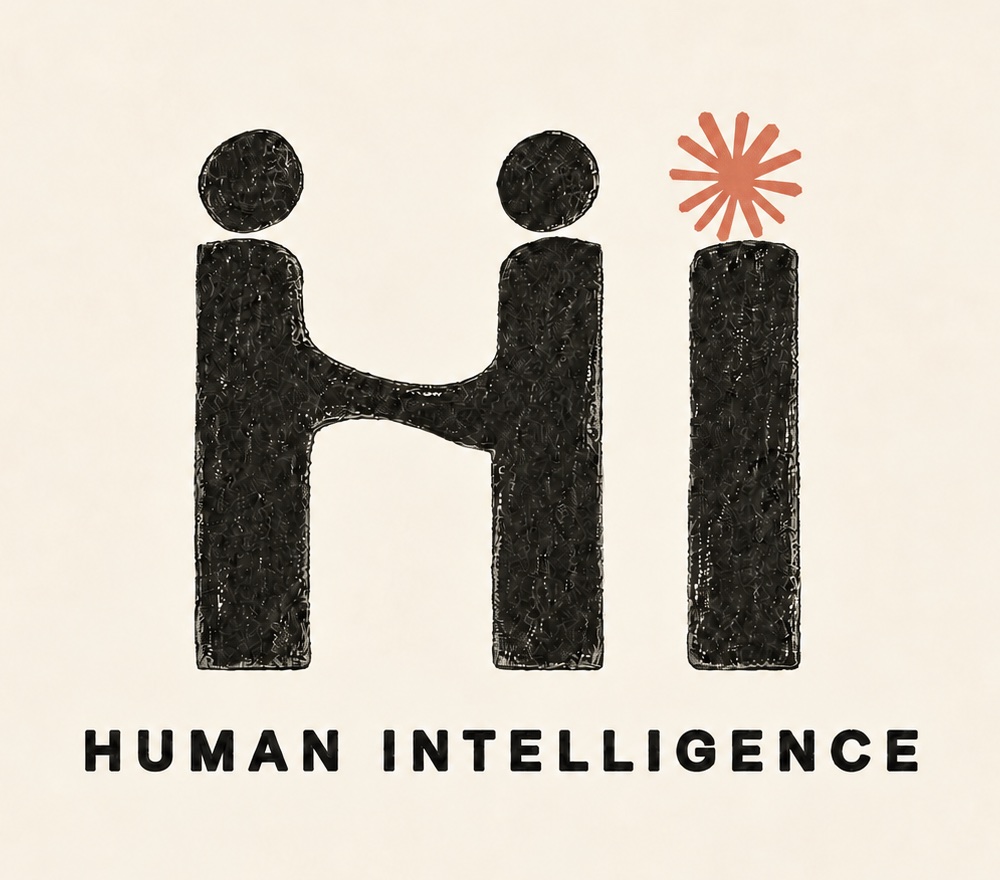
∞ · Human Intelligence
The spark was always ours.
A fire, a handprint, a hand held out, a line in clay, a lens, a flag — and now a new mind beside our own. The shape keeps changing. The hands holding it are human.